The Kerosene Taste of Childhood
- Bethany "Batya" Klein
- Jul 26
- 59 min read
Note: This poignant, semi-autobiographical narrative has been translated into English to support the ongoing preservation of Krymchak history, heritage, and memory. Originally shared on the historical community portal "Krymchaks.info" by researcher Mikhail Gurdji on January 5, 2021, the text was authored by Larisa Mangupli, a prominent Krymchak journalist and writer.
Born in Kerch, Crimea, Mangupli worked extensively for Crimean, Ukrainian, and Russian newspapers before repatriating to Israel in 1995. She is a member of the Union of Russian-speaking Writers of Israel, the International Union of Writers, Journalists, and Artists (UK), and the editorial board of the Krymchak almanac "Kъrymchahlar". She has dedicated her literary career to documenting the Krymchak experience, authoring several books including The Kerosene Taste of Childhood (2003), Like the Lines of a Palm... (2009), and My Dear Krymchaks (2011/2019).
Drawing directly from her family's history, this work is a harrowing true account reconstructed from the firsthand memories and oral testimonies of Mangupli’s older sister, Sofiyka, and her mother, Malka. Because the author was only an infant during the war, she relies on her sister's lived experiences to chronicle the family's grueling evacuation to Kazakhstan during World War II. The story then follows their devastating return to a ruined Kerch, where they discover the tragic fate of their relatives who were exterminated by the Nazis in the Crimean Holocaust (December 1941). The narrative concludes with a deeply moving letter written by the author in 2003 from Haifa, Israel, to her late mother, as she registers their murdered family members at Yad Vashem to ensure their souls—and the memory of the Krymchak genocide—are never forgotten.
Where are you, Promised Land? No matter how hard Malka tried to fall asleep, she couldn't. For the umpteenth time, she squeezed her eyes shut as tightly as possible, but they imperceptibly, almost of their own accord, flew open again, and the imaginary pictures floated away like a cloud. In the evening, as her mother tucked little Shebetey and Klara in beside her, she said the children needed a good night's sleep because they would be leaving at dawn, having to wake up before the sun. “…I wish it were morning already. How will it all happen?” Malka was overcome by very unchildlike thoughts. She was moving for the first time and couldn't imagine having a home and friends anywhere else. Her dad promised that there, in faraway Palestine, she would go to school, study, and learn many, many things. And in general, they probably wouldn't have to live in poverty like they did here, and she, Malka, would have her own separate bed.
Malka was already six years old. She was the eldest, and the responsibility for her brother and two-year-old sister fell on her. The girl carefully pulled up the edge of the felt that served as a mattress, tucked her baby sister in better with an old blanket, hugged her close, and closed her eyes. She dreamed of seeing at least something her father had been talking about lately. A land where it never snows and is always warm, where palm trees grow and mountains gleam like gold. He also called this land the Promised Land and the land of her, Malka’s, ancestors. Of course, she didn’t understand everything. Her grandparents and all her relatives lived right here in Crimea. Many lived in their very own town of Karasubazar. But that didn't matter; her dad knew what he was talking about. To her, Malka, he was an authority. She saw how everyone around respected him. Even though he wasn't a man of great importance—he worked for a winemaker—life had endowed him with a strong character, a clear mind, and the belief that sooner or later, everything would be alright. That’s why people came to Abraham for advice and a kind word.
When people were in the house, her mom and dad believed the children had no business being there. Yesterday, when adults came over and her mother started making coffee for the guests, her dad said: "Go on, daughter, go for a walk."
She didn’t want to go anywhere. She tried to help her mom, not understanding where the cups and coffee maker had come from, since her parents had given absolutely everything away in preparation for the journey. Just yesterday, an eighbor dropped by: "Bas-Sheva, won't you leave me your kettle as a keepsake?"
As for Malka, she didn't regret giving anything away, as long as they would have everything there, in Palestine. Even this little house where they were sleeping their final night had already been sold. Her parents didn't tell the children the details, but the eldest daughter knew that the money had been used to buy gold rings, earrings, and bracelets. All these jewels fit into a small pouch that her father guarded dearly. Who knows what a long journey might bring? The whole street knew about their departure tomorrow. The boys and girls were clearly jealous of Malka. And why wouldn't they be! She was going to see so many new things! As for the adults, they were completely different. She herself had heard one of her father's acquaintances trying to talk him out of it. Where are you going, Abraham? he had said. These are troubled times. Tsarist Russia has fallen; who knows what will happen tomorrow or what to expect from the new government. Anarchy is running wild in the country...
Naturally, Malka understood nothing of this. She did know the word "revolution," though. Because it was on everyone's lips. True, she didn't understand whether they were able to leave because of this revolution, or if they were fleeing their home because it had happened. Most likely, yes, they were leaving because of it. Everyone knew how many tears were shed when the synagogue in their town
was destroyed after the revolution. The men were gloomy and walked around as if in mourning, and the women cried quietly. Malka remembered how, just recently on the joyous holiday of Simchat Torah, her dad told her: "Our Shebetey is still too small. Get ready, daughter, you will go to the synagogue with me." Malka's breath caught with joy. In a rush, she smoothed down her thick black hair, braided it, put on a clean dress, hastily slipped into the shoes she shared with her little brother, and flew out of the house like a bullet. Her father walked fast, and Malka could barely keep up, trying to match his wide stride. She didn't immediately realize what was bothering her. Only there, in the synagogue, did she notice that her left shoe was on her right foot, and the right was on her left. Not daring to change her shoes in that holy house, she stood there in discomfort for several hours.
Oh, the things Malka remembered on this wondrous night! Her entire six-year-old life flashed by like a single day. Tomorrow a new, unexplored life would begin. The little girl had no idea that she would never see her cherished Palestine, would never learn to read Hebrew, and that for many, many years, her memory would retain only a few mysterious letters from the ancient prayer books her father prayed from—letters that held so many secrets... She would also remember a wide wagon lined with that same felt, riding along a dusty road with her parents, brother, and sister. The driver kept urging the oxen on—they had to reach the port of Feodosia on time. Next to them were bundles of household belongings, a sack of hardtack, a bucket of brynza (cheese), a small barrel of clarified butter, and water sloshing in a canister... Apparently, fate really is the master of all. Abraham was not destined to step foot on the land of his ancestors. "Where are you headed, good people?" they were asked at the port.
"Not to Palestine, are you?" Abraham nodded in agreement. "See that steamer over there?" a port official pointed to a tiny vessel barely visible in the sea haze.
"Well, that was the last trip to Palestine..." For a long time, whenever Abraham remembered this story, he couldn't decide whether to be upset or relieved. That is, until it became known that in the open sea, pirates had robbed the passengers and sunk the ship with everyone on board.
You will live a long time, sister.
Izya hugged his sister tightly and kissed her. They hadn't seen each other in a long time. In the meantime, he had gained another niece. He had only seen the eldest, Sofiyka, a few times during his year of studying in Moscow. He couldn't visit often—it was too expensive for a student. The girl had grown so fast; she would be starting school in a year. Little Larochka wasn't even three months old. She lay in her crib, looking with huge brown eyes, as if studying this new person. Izya smiled at the baby and gently hugged his sister: "You're our smart girl, Malochka. Your and Isaac's girls are just lovely. And this little one, you'll see, came into this world to be lucky."
He said this, then grew thoughtful, retreating into himself. It was as if something known only to him had carried him very far away. "Iz-ya... Where are you?" she shook her brother. "Come back..." "Here, let me see your hand."
Still thinking about something else, he peered at the lines on her soft palm. "You are going to live a very, very long time, sister." Malka smiled. Of course, she had people to live for. "Well, thank you, brother, for such a prophecy. How did you know?" "I calculated it. Did I graduate in physics and math for nothing?" "Of course, of course. How did I forget? I know you dabble in palmistry," Malka remembered. "Then tell me, how much time is measured out for you?" "Not much, my dear. Not much at all. But please, live for all of us. And may our Creator protect you." Malka felt uneasy at these words: "live for all of us..." But she chased the anxious thoughts away, distracting her brother with another topic. They had little time together—Izya was being assigned by his institute to Barnaul, where he would be a physics and math teacher at a school. She still had so much to ask him about, as her brother had just come from Simferopol, where their parents' home was now located (ever since the failed trip to Palestine). The sister wanted to know how their dad was doing, about their mom's health, and how Shebetey and Dusya were. Was their chubby little Mishutka still the angel she had seen six months ago? Claudia's three-year-old son, Zorik, was younger than his cousin but tried to imitate him in everything. Yes, everyone now had their own family, their own worries, and their own joys. And as the eldest, Malka was interested in it all. The youngest in their family was Hannah. She had just finished school and was going to continue her studies.
A wonderful age—seventeen. Everything was still ahead of her...
Tomorrow was the war Sofiyka loved to greet her dad when he came home from work. She would go out the gate and wait. Spotting his familiar figure from afar, she would dash toward him. She’d run up, wrap her arms around his legs, press herself against him, and freeze for a moment. She waited for her dad to lean down, kiss her, and dote on her. No, no one had offended her. Like any child, she simply craved attention and affection. Even though she knew his first question would be whether she had kept an eye on her little sister and if the baby was okay, she still secretly longed for a display of fatherly tenderness.
In their family, such secret feelings weren't typically discussed even with her mom. There was no time for that. Everything revolved around work. Even now, right from the threshold, her dad would ask her mom, "How are things?", glance at his little daughter, and get straight to work. He called it his second shift.
To keep the family from poverty, he had to sew chuvyaki (light leather slippers) in the evenings. Elderly people wore them, and he had steady customers. But they didn't buy shoes every day, so her mother had to sell them at the market. Sofiyka knew this came with difficulties, and often her mom returned with unsold "goods," or worse, with neither the shoes nor the money... They didn't share the
details with the little girl. But once she accidentally overheard her mother saying that the finance department caught her and confiscated everything. Sofiyka didn't know who this "finance department" was, but it seemed very evil and ruthless to her. Wasn't it obvious that if her mom didn't sell the shoes, she’d come home without food?
It’s truly said that nothing is faster than a thought. Even now, in just an instant, so many thoughts flew by that Sofiyka didn’t even immediately realize how she ended up in her dad's arms. Tightly pressed against his warm, scratchy cheek, she held a bundle of twigs tied with twine, covered in tight brown buds.
"These, daughter, are chubuki (grape cuttings). An old Tatar man named Murza brought them to me. When we get home, we'll dig some holes and plant them. Do you see the buds? Soon they'll open up, leaves will appear, then branches... Our little Larisa will grow, and these grape bushes will grow along with her. And in a few years, we will all cut ripe bunches of grapes together."
From then on, she began every new day by visiting the seedlings. They grew in the yard by the wall
of the summer kitchen. The girl would secretly run out here even later, when their own yard became alien and inaccessible, when people in military uniforms became its masters for a long time. But that would all come later. For now, the immediate "tomorrow" brought terrible news: the war had begun. Very soon, the Germans were already occupying Kerch. Normal human life shifted into a completely different dimension. "Mommy, what's going to happen to us now?" Sofiyka asked, noticing her mother's tear. Malka tried not to show her anxiety to the children; she didn't cry or panic in front of them, but this time, apparently, she hadn't managed to brush away the uninvited tears. Her eldest
daughter was at the age when the world reveals itself not just every day, but every hour, every minute. She was the kind of child who tried to process everything she saw and felt for the first time by herself, and if she couldn't figure it out, she asked adults. So Sofiyka, while remaining outwardly calm and composed, lost her smile, took no joy in her toys, and increasingly sat by the window overlooking the yard, staring at a single point. That point was the grape cuttings, which had taken root so well and were already adorned in sticky little leaves.

"Why so sad?" her dad asked one day, noticing his daughter's pensiveness. "But if there is a war, what will happen to our little plants, and to us too?" Her dad fell silent, hugged his daughter tightly, kissed her, and tried to calm her... "Well, answer me, answer me, Mommy," Sofiyka persisted, but instead of an answer, she heard loud voices coming from the street. Now they were talking somewhere at the front of the yard, right by the gate... Isaac and Malka listened closely and realized—the German occupiers had arrived along with the local police. Just a minute ago, the family had been greeting a new, anxious day over morning tea. Now, they resembled frightened birds. That's what happens when the heavy paw of a wild beast suddenly looms over a nest. Malka pushed aside the wicker table along with the reed chair and darted into the next room. Laying Larisa, who had been sleeping in her arms, into the crib, she pressed her eye to the keyhole. Isaac pulled Sofiyka close: "Just don't be afraid, daughter. Everything will be fine..." Malka's heart pounded heavily. Now she could not only hear but see the scene at the gate. Their neighbor, Tatyana Makarovna, was talking to an SS executioner and a policeman. "Well, speak up, old woman, are there any Jews left here?" the German asked with an accent. "There are no Jews here," the neighbor replied, stuttering slightly and nervously smoothing her
apron with trembling hands. And then, unexpectedly, she clarified that while there were no Jews, there were Krymchaks. "Show me where these Krymchaks are hiding," the German ordered. "Over there," the neighbor turned her unseeing gaze toward apartment number three. Blind since childhood, how could she know that butchers had come calling, the mere sight of whom made a normal person's heart freeze... Malka saw the arrogant, trim SS officer in a black uniform and the policeman with a rifle accompanying him. It was their neighbor from down the street. When they approached the door, Malka instinctively shrank back toward her husband. "Passports!" the uninvited guest barked viciously. While her dad retrieved their passports, Sofiyka slipped out of her mother's embrace and in a second was behind the door of her parents' bedroom. Through the narrow slit, her eyes caught glimpses of the swastika on the sleeve, the holster strapped to the belt, the highly polished, squeaky black boots... Sofiyka saw her dad, his face flushed crimson with anxiety and fear, open his passport first, then her mom's, holding the documents right in front of the German's face. The man slowly read
the names and surnames of her parents out loud. "Krymchak man, Krymchak woman. Isaac, eh? And what are you—Malka-Chaya?" the German laughed mockingly. Then he swept his gaze, full of hatred, over the hosts. Having heard rumors that the Jews of Kerch had already been shot and that it was apparently the turn for mixed-marriage families and Krymchaks (indigenous residents of Crimea), they stood before their potential executioners drained of all moral and physical strength. One of the uninvited guests asked her mom something. Sofiyka caught a few familiar words in this strange speech. But they sounded weird, distorted.
She understood the word "partisan" immediately. But her mom answered that there were no partisans here. Then the German shouted something, prodding her dad's striped sailor shirt with his submachine gun. Her mom tried to explain that her husband was disabled and had no connection to the army. The German fell silent. Then he pointed his whip at a square cardboard box and a gramophone. "Play,
play," he ordered her dad. He forced him to sort through the records one by one, looking over his shoulder and reading them, smiling with satisfaction and baring large white teeth: "Got a waltz? Play, play... Schubert... Strauss... Kálmán..."
Whether her mom, understanding the situation, had hidden the records with Tatar songs, or whether they just didn't happen to be in that box, Sofiyka would never know. Regardless, with the German's smile, her fear subsided a bit, and she peeked out from behind the door. At that moment, the Gestapo officer pulled an apple from his pocket and, without removing his leather gloves, began eating it,
biting into the shiny, rosy fruit. He kept asking questions, crunching loudly on the juicy apple and spraying saliva. It seemed to Sofiyka that the Germans were finally getting ready to leave. The first one looked into the crib where her baby sister slept, and ruffled Sofiyka's hair, brushing her cheek with the cold leather of his glove and throwing her a contemptuous look. But that wasn't all.
They literally scoured the apartment like rats. They took the records they liked, bedsheets, gauze, soap, and medicines, and demanded kerosene and candles. And when one of the executioners kicked their wicker reed table with his boot, sending it crashing down along with the dishes and their half-eaten breakfast, Sofiyka felt truly sick. For a long time, she would remember the sound of shattering cups and saucers, and the puddles of tea and milk. Evening came...
There had been no electricity for a long time. Huddled at the edge of the table, the girl stared at the dim flame of the oil lamp and thought: “It’s a good thing Mommy managed to hide the bottle of kerosene from the Germans back then, otherwise what would we do right now in the dark?”
“Dear Mrs. Malka-Chaya Mangupli! By sharing your memories of what you endured during the Holocaust with us, you have given generations the opportunity to feel a personal connection to history. Your interview will be carefully preserved as an important part of the most comprehensive library of testimonies ever collected. In the distant future, people will be able to see the faces, hear the
voices, and learn about the fates. They will be able to listen, learn, and always remember. Thank you for your invaluable contribution, for your courage, and for your generosity of spirit. With deep respect, Steven Spielberg, Chairman of the Foundation. Los Angeles, California.”
This letter, dated November 23, 1998, was attached to a VHS tape containing my mother's memories of her distant pre-war and post-war childhood, of everything connected to our family’s history in the pre-war years, during the days of fascist occupation, in distant Central Asia where we were evacuated, and in the post-war era. I watch this tape, and the uninvented story transports me to the
early post-war years. I see my mother's face—beautiful, young, smiling. At times, though, it was covered in bitter tears over what was lost, because the spiritual wounds could not heal without giving back at least a fraction of the pain carried by a mother's war-torn heart. And we, the children, learned from a young age to understand this pain, to unconsciously take it upon ourselves, because my mother's entire large family—her parents, brothers, sisters, and their children—were shot and tortured to death in the Gestapo dungeons in Simferopol. It is no wonder that my hatred for fascism, my awareness of the tragedy, losses, and the tragedy of our people were born precisely from this pain of my mother's, which I absorbed with her milk and her tears...
The autumn of 1941 brought many disasters. Soviet troops had already abandoned Kerch, and the Germans were approaching the city. Times were so heavy that the very thought that the fascists would be the masters here any day now, with all their cruelty, chilled the soul. A few days before the occupation of the city, three Red Navy sailors appeared in the courtyard of the house—wounded, with
bleeding injuries. They could barely stand. The soldiers begged for civilian clothes and help finding the Adzhimushkay quarries, where Soviet fighters were still holding the defense. Someone had told the sailors that it was the only place they could be saved. The adits near Kerch, left over from limestone mining, were now a more or less reliable haven. In these tunnels, fighters held the city's defense for a long time. The civilian population—the elderly, women, disabled, and children—also hid from the Germans there. The young men were met by our neighbor, Alexander Gavrilovich. The elderly man was seriously frightened... What should he do? From anxiety, he stuttered and fidgeted even more than usual. “What should I do?” the old man agonized. Just the other day, he and his wife had received two "death notices"—two of their sons had died heroic deaths at the front, and there was absolutely no word from the third. “How is our Viktor doing? Maybe he is wounded and can't even write a letter... God help him,” Alexander Gavrilovich crossed himself with a trembling hand and led the sailors to the shed. "Isaac, Isaac! Come out for a minute, please," he knocked on the window. Sofiyka would later learn that her dad and Alexander Gavrilovich helped the sailors bandage their wounds, fed them what they could, changed them into civilian clothes, and showed them how to sneak through the backyards toward Adzhimushkay. They threw their military uniforms into an
abandoned well. Tatyana Makarovna had said that it used to be a working well, and her parents and grandparents had used its crystal-clear water. When the spring dried up, the well was turned into a dump. Now, to cover up the tracks of the military men, they filled it with rocks and sealed it forever. “That’s good,” Sofiyka thought. “Now no one will know that Dad saved these sailors' lives. If only they found the way to the quarries...” The girl constantly asked her mother to explain everything that was happening to them, to the people around them, and to this world that had become so alarming—her mother had more patience than her dad, and the ability to understand her childish soul and calm
her. At least for a while, for an hour...
Every time I sit down at the computer, and the theme of the war is ready to burst from my soul, my mother's face from those distant post-war years clearly appears before me. On this videotape, she may seem calm. But I know that the pain did not leave over the years; it simply dulled. Perhaps that is why my mother talks about everything without overt tragedy, as if what she is describing didn't happen to us at all. But suddenly, something burns me, my breath catches, and a lump rises in my throat. And I begin to understand where this almost tangible, cloying-bitter taste on my lips comes from, and why,
haunting me for so many years, it became a persistent allergen—a pain causing nausea and almost a clouding of consciousness.
...November 1941
In the main square of our city of Kerch, an order from the German command was posted stating that all Jews must appear at the square with a three-day supply of food and valuables. Those who did not appear were later found and shot on the spot... A reminder of that time is a document obtained
years later from the State Archive under the Council of Ministers of Crimea. It states that I, my older sister Sofa, and our parents were registered in the lists of residents for November 1941 in the Fund of the Kerch City Administration during the period of the German-fascist occupation. This implies that upon the very first order, we were supposed to report to Sennaya Square. Only later did it become obvious that the Nazis were preparing for the mass execution of the Krymchaks.
The dark, low cellar of the old barn, completely covered in cobwebs, choked them with the smell of mold and frightened them with the rustling and squeaking of mice. Sofiyka was terrified. But this was nothing compared to when the bomber raids deafened them. Their drawn-out, howling drone, almost always followed by explosions, seemed to penetrate every cell of her body and exhaust her fragile
being for a long time. Right now, the girl slowly stood up and listened. All the time it had been buzzing and whistling up there, she had covered her baby sister and pressed her palms over her own ears as hard as she could. So it wouldn't be so loud. Larisa was still just a tiny thing; she understood nothing. Yet, Sofiyka never ceased to be amazed at how this baby sensed every incoming bombing. She noticed: if the baby dropped her pacifier and anxiety froze in her wide-open eyes—expect the German "vultures." That’s what the adults called the enemy planes. They too began looking at the child as a kind of early warning signal. "Mom, Mommy, I'm so hungry..." "Be patient, my dear, be patient. When Dad gets back, maybe he'll find some bread somewhere." She said it, but thought
to herself: “What bread, when our troops, retreating, burned and blew up absolutely everything just so the Germans wouldn't get it.” Sofiyka also relied heavily on her dad. He was the kind of person who could do anything. But he wasn't taken to the front because he was disabled from childhood. She had only just learned this. Earlier, before the war, when the neighborhood boys would ask, "Why is your dad's neck crooked?", she would just brush them off and call them liars. She remembered how recently, when the radio had just announced that the war had begun, but life still hadn't changed much (except for the anxiety in the adults' eyes), her dad received a summons to report to the military
enlistment office. Her mom explained that Dad would probably be sent to the front to fight, to protect the country, kick the Germans out, and not let them rule here. Sofiyka was terribly worried that she and her mom would be left alone. Who would protect them then, if not Dad? But by evening, her dad returned home and said the medical commission in Kerch hadn't cleared him to be drafted into the Red Army because of his childhood disability. But this conclusion had to be confirmed by another commission located in the military enlistment office in Feodosia, and her dad had to go there urgently.
It was already dark; a wind had suddenly blown in from the sea. Or rather, from all sides, because Kerch is the easternmost point of the Crimean steppe and is washed by two seas simultaneously—the Black and the Azov. Sofiyka hated this strong wind—it was so piercing and blew so much dust into her eyes that it hurt to look. She just wanted to be in the warmth, leaning against the stove that smelled of fresh lime with firewood crackling inside and fiery flashes dancing on the wall, or to hug her mom tightly. It was always so warm and calm next to her. The image of seeing her dad off flashed so vividly that for a moment, Sofiyka felt as if she were back there at the gate of their house. Her dad,
worried and nervous, with a duffel bag on his shoulders, hugging her mom: "Don't worry, Mousie (that’s how he loved to address her, putting the stress on the last syllable in the French manner), I'll be back soon." Her mom was holding Larisa wrapped in a blanket, and the gusty wind played with her flared skirt, ballooning it out as if turning it into a steppe bluebell. Sofiyka clung to her mom.
...They expected Isaac to return the very next day. But he didn't appear tomorrow, or the day after. Only on the fourth day—hungry, exhausted, unshaven, and suddenly looking as if he had aged—did he collapse at the threshold like a felled tree. For three days and three nights, he had walked without rest, food, or sleep from Feodosia to Kerch with one thought: to reach his family. Having received a "white ticket" (medical exemption) as a man unfit for military service or combat, he had effectively been left to the mercy of fate. There was no transport to take, passing cars on the roads were almost non-existent, and if they did appear, they were carrying military personnel who had no time for a
lost traveler. And it was dangerous to appear on a deserted highway—it was wartime, after all. So he charted his route through villages, copses, and along railway tracks until he reached his hometown. Since then, her dad was always with them. So, Sofiyka thought, it turns out his disability saved him for her.
Swallowing her hungry saliva, she forced herself to be patient and wait.
...Carefully opening the gate, Isaac peeked out into the street. Not a soul. But the sight... Only piles of ruins remained of the houses across the street. Something in them was still burning, turning the remnants of the former, pre-war life into ash. The wind forcefully carried this bitter smell of smoke
everywhere. “Maybe I can find something in these ashes?” He had barely crossed the road when he heard the clatter of hooves, and a two-wheeled cart rolled out from the corner where 23rd of May Street and Pirogov Street intersected. "Hey, neighbor," the driver called out, "need flour? I can sell you some if you want."
Isaac couldn't believe his ears—had God Himself sent a savior? "Got about ten kilograms here in the sack. Hand over three hundred rubles and take it." "Thank you, brother," Isaac hugged him, handing over the money, "I'll never forget this." Once home, when they opened the sack, they smelled the pungent odor of kerosene. They understood then what had happened. Before the Germans entered the
city, many things were burned and destroyed, including food stored in warehouses. So the enemy wouldn't get it. Apparently, the flour, doused in kerosene, hadn't burned in time. And the prompt neighbor hadn't missed the chance to make some money off it.
A quieted Sofiyka watched her mom light the primus stove. She pumped the stiff pump, and when the little cup filled with kerosene, she struck a match. The flame instantly rose in a bright column, lighting up the cellar, and the girl saw her mother's face covered in tears. She didn't understand why her mom was crying—they had flour now, which meant they would have something to eat... Yesterday, her mom had cried too, when she brought water from the pump. But that made sense—she had been badly frightened because a fascist almost shot her. Sofiyka knew very well that they couldn't go out into the yard or the street, because the Germans patrolled day and night. One of them, seeing her mom at the water pump, aimed his pistol at her. But then he noticed a Soviet soldier running from the lower street up Mount Mithridat, and was distracted. Waiting for him to get closer, he fired. Her mom saw the young man fall dead, and the German hurried over to him. Meanwhile, her mom managed to run away. She recounted this barely catching her breath, trembling with anxiety. Sofiyka had gently taken the half-empty copper kettle from her mother's hands.
When the flame turned into very small orange tongues, her mom pumped it again, cleaned the nozzle hole with a special needle, and a strong bluish fire streamed from the tiny holes of the burner. The cellar filled with the cheerful, chattering buzz of the primus, and soon with the smell of fried flatbreads, which overpowered the suffocating kerosene stench. "There you go, little one, now we're going to eat..." Sofiyka, acting like a little mother, carefully tucked a ringlet of silky hair under her sister's bonnet, took the empty bottle from the baby’s little hands, and smoothed out the blanket. She pushed the galvanized washbasin in which her sister lay closer to the crate that served as
a table. This basin served as both a bed and a cradle for her sister. Oh, how appetizing those little golden loaves smelled! Her mom poured everyone a mug of boiling water flavored with the last of the jam and handed out a flatbread to each. She broke off an edge for little Larisa. The baby gripped it tightly in her tiny fist and began to suck on it, smacking her lips. Sofiyka bit into the crispy crust and coughed—the taste of kerosene caught in her throat. The girl took a sip of the sweet liquid from her cup and... began to cry. But she was so hungry that she swallowed the warm, crispy pieces, choking and wincing, flavoring them with her bitter-salty tears.
...The first post-war years also added a kerosene taste to our childhood. By then, there were three of us children. All the girls had beautiful long hair. Our parents couldn't bear to shave our heads bald, but the only way to protect against lice was with kerosene. I remember how, after every time we washed our hair with rainwater and laundry soap, Mom would pour a generous amount of this
foul-smelling, bluish-yellow liquid into her palm and thoroughly coat our hair with it. It became smooth, shiny, and clean. The smell, of course, evaporated very quickly. But it turns out it lived inside me for many years to come. Not even as a smell, but rather as a taste. Bitter and acrid. The very same taste I felt so vividly on my lips when my mother's story unearthed the deepest layers of my memory. That was the kerosene taste of our bitter wartime and post-war childhood.
This strange, incomprehensible world A short time later, the family was hiding in the cellar not of their own home, but of a neighbor's. A military unit headquarters had set up in their apartment. The soldiers arrived, moved all their belongings into the shed, and found a small room for the residents in the yard next door. Here, again underground, Sofiyka found it dark and chilly. And boring. The constant feeling of hunger made her nauseous. Holding her breath, she listened to every sound coming from above, waiting to hear Uncle Grisha's footsteps. She recognized them instantly: clack-clack on the stone steps. She had seen her dad nail metal horseshoes to the heels of his boots himself. Those were what were clacking. Uncle Grisha was the headquarters cook. He pitied their family deeply. Tall, with a lush mustache and eyes as blue as the sky, he resembled a kind Grandfather Frost (Santa Claus). He would carefully slide back the bolt and slowly push open the creaky door. "Well, how is our mommy and her kids doing down here?" Uncle Grisha would ask, holding out a mess tin of
buckwheat porridge. "Here, eat, you have a baby to feed..." And he would always pull something out of his pocket for Sofiyka: a sugar cube, or a hardtack biscuit that tasted better than any cookie. Once, to the girl's delight, he brought a small piece of paper and an indelible pencil. "Here you go, daughter,
draw whatever you like. Or practice writing letters. Soon the war will be over, and you'll go to school, into the first grade." Sofiyka knew that Uncle Grisha had a daughter just like her back home in his native Ukraine. Once he came and brought her mom woolen socks. He had knitted them himself. "Take them, they'll come in handy." Her mom didn't know how to thank Uncle Grisha for his kindness. And the socks truly did come in handy during the severe frosts in distant Kazakhstan, where the whole family soon had to evacuate—the enemy was on the outskirts of the city for a second time. But if it hadn't been for Uncle Grisha, who knows what would have happened after one of the bomber raids when the cellar was completely buried. He was the first to raise the alarm, brought soldiers,
and cleared the rubble...
...Litvinka. Sofiyka heard this word for the first time. Her dad whispered it as he and her mom packed their things. Everything fit into two sacks. In one—hardtack; in the other—documents, photos, and children's clothes. They left at dawn, right after the bombing temporarily stopped. Sofiyka begged her dad to let her run home for just a minute to say goodbye to Uncle Grisha and to water her saplings at the same time. "Don't worry, kiddo, as long as we're here, I'll keep an eye on your little plants. Everything will be fine. And them," Uncle Grisha looked up at the departing planes, "we will definitely drive them away..."
At first, Litvinka wasn't bombed. This city outskirt didn't attract the attention of the German aviation. Flying over it, planes with huge black crosses on their wings almost touched the roofs, and you could easily see the Germans pressing their faces to the windows, ready to unleash a burst of machine-gun
fire at any moment. However, it was impossible to keep restless kids inside. It's understandable—childhood has no fear. Sofiyka, too, hearing the drone, would run out into the street with her new friends. The terrifying "birds" were heading toward the port, factories, and mills. "One, two, three, four..."
Sofiyka counted on the fingers of one hand, then the other... But the planes kept coming and coming. She only knew how to count to ten. So an older boy gave her her first math lesson: "Eleven, twelve, thirteen..." "Oh, Mommy," Sofiyka ran joyfully into the hut, "guess what, I learned, I learned!... I already know how to count to twenty!" The little girl didn't yet know that the machine-gun fire from the twenty-first plane—the last in the deadly wedge—had ended the older boy's life... After that, the children were no longer allowed out on the street. Sofiyka, an open and kind soul, grew utterly bored. Larisa was an amusing little sister, of course, but she was still too small. You couldn't play with her, or talk about important things, or draw... The girl took out her treasured ink pencil, Uncle Grisha's gift, carefully folded the piece of paper, and settled on the windowsill. It was lighter here—dusk was falling, and they didn't turn on the light in the hut because of the blackout. The great thing about this pencil was that if you moistened the lead just a tiny bit, you didn't have to press hard, and the drawing or letters came out bright and clear.
Sofiyka drew a traditional little house with a window, a door, a conical roof, and a chimney with a spiral of smoke rising into the sky. And, of course, a fence. But this time, the house was merely the background for the main detail of the drawing: a grapevine. It looked strong, resilient, as if it were singing a little song. About what? About how good it is to bask in the sun's rays and nourish delicate carved leaves with its sap. The leaves really did turn out exactly like the real ones. It didn't matter that they weren't green, but purple. They were painfully familiar and even dear to her. This ink-pencil
drawing reminded her of their very recent past. In the first months of the war, bread wasn't sold in stores so that people wouldn't gather in long lines. It was delivered to homes. Every day at the same time, Sofiyka went out the gate and waited for the wagon. All the neighbors waited for it. She would receive the family ration in a treasured white linen bag, upon which was written, also in ink pencil: "Bakshi I.Ya., 23rd of May, 45." In return, she would hand over an identical, freshly washed, and ironed bag.
...There was a timid knock at the door. Her mom opened it—on the threshold stood a neighborhood girl, Klava. She was a local from Litvinka. Sofiyka had befriended her and loved playing near the house. But now it wasn't allowed, so her mom let her go visit for a short while. The girls were good together; they were the same age. Klava had many toys and colored pencils—you could draw as
much as you wanted. Time flew by unnoticed. A tingling pit in her stomach reminded her that she had stayed a long time. Klava's mother poured milk into a mug, scooped a mound of cookies from a paper bag, and led her daughter into another room. "And for my Sofochka?" Klava resisted. But her mother forcibly pushed her daughter along and said almost in a whisper: "Eat it yourself, I said. We don't have enough to be feeding Yids on top of everything..." At home, her parents tried to explain this to her, but Sofiyka still didn't understand what was happening in this strange world. And how could a six-year-old child know that the mug of milk hidden from the dark-eyed girl was only the beginning
of what they would have to endure during this war, and after it, too?
The word "evacuation," unlike the word "occupation," was both new to Sofiyka and very difficult to pronounce. Her dad came home agitated and said that early in the morning they would have to leave for the crossing. There were no civilian boats, only military ones, and they had to get to the Caucasian shore at any cost. Even at the risk of their lives, because staying on this Crimean land, where the fascists were already the masters, meant there was no chance of survival anyway. Sofiyka listened to her dad, and her child's imagination painted strange pictures for this time: at one moment, they are soaring over the water on a flying sailboat, while down below, pillars of fire rise up, then sharply fall and extinguish in the sea's abyss; at another moment, they are flying on a magic carpet with a funny, white-bearded old man... But very soon, these fairy-tale plots dissolved, gave way to a harsh reality that would for a long time eradicate her smile, laughter, recklessness, and belief that the world is bright and beautiful, and that good always triumphs over evil. A reality whose name is War.
Crossing to the right bank Tomorrow was May 6, 1942. More accurately, tomorrow hadn't even arrived yet. In the pre-dawn haze, Sofiyka couldn't see anything. It was so hard for her to walk, and she desperately wanted her dad to hold her hand. But he was somewhere up ahead. And his hands were full anyway. Even though they only took the bare necessities, the sacks turned out to be heavy. And she had her own load to carry—a pot with porridge in one hand, a kettle with water in the other. She stumbled but kept walking. Her mother's white woolen shawl, worn over a dark cloth coat, acted as a beacon in the gray night. Her dad had tied it that way so it would be easier for her mom to carry Larisa. On her mom's back was a sack of diapers and necessary baby things; on her feet were her dad's
heavy boots. The road to the crossing was long. They only arrived in Kapkany by morning. They had to wait out the day in this small fishing village until nightfall and then hit the road again. Sofiyka saw her dad give a whole stack of money to the owner of a little house on the edge of the village, and he allowed them to stay until it got dark. On the condition, of course, that they "don't show their faces around here." Everyone knew what happened if you hid Jews, Krymchaks, or Roma... Sofiyka didn't see her dad at all during the day—he didn't sit in the house. But by evening, he returned with good news: there were several Krymchak families here, they pooled their money, made a deal with a local
fisherman, and they had to be at the pier at two in the morning. The fishing felucca would take everyone to the crossing, and from there, the Caucasus was just a stone's throw away. At that time, they didn't know in Kapkany that the Germans were already in Litvinka, that their aviation was bombing the crossing "at full throttle," as her dad said. And that very evening, the fisherman who
intended to help the refugees escape death would perish under his own destroyed house. "Oh, look, look how many soldiers there are!" Sofiyka lifted the lace window curtain. "Those are our soldiers! Right, Mom?" At that moment, some force seemed to rip her mother from her spot. Holding Larisa in her arms, she ran straight out into the street. She was agitated and seemed to be searching for someone in the column of men. "Malka, Malochka, is that really you? What are you doing here, why aren't you leaving?" In the tall, handsome young man, her mom recognized the Komsomol organizer from her canning factory, where she had worked before marrying her dad and moving from Simferopol to Kerch. "Don't you know they are already bombing the crossing and civilian evacuation has been halted? They are only ferrying the wounded and sick to the Caucasus. Take your family
and leave here immediately."
And so, another night on the road. For Sofiyka, it was even harder than the last. They had to walk along a narrow path. To her right was the sea, to her left—the steppe with incredibly thorny bushes, and behind them lay the plunged-into-darkness houses of the villages Kapkany and Opasnoye ("Dangerous").
Now the girl understood why these places had such strange names. It really was very scary and dangerous here. Even her dad struggled to find the way. The entire coastal strip was either slippery, muddy ground, huge boulders, or suddenly emerging hills with deep crevices. It was hard, and she had no strength left. She wanted to just cry from exhaustion. But she had to endure. The worst
part was that they couldn't even stop to rest because they had to make it before dawn. By the ruins of the old Yeni-Kale fortress, her dad allowed a short halt to change Larisa's diaper.
The mysterious word "crossing" appeared before Sofiyka as a total nightmare. The roar of airplanes, the whistling of bullets, the explosions of artillery shells, the screams and groans of the wounded. A military patrolman with a submachine gun paced along the shore. He didn't let anyone near the boats and threatened to shoot if anyone dared approach. Sofiyka was terrified: she had never seen so
much blood or so many dead and wounded people. Medics laid them on stretchers and carried them up planks onto the boat. The crossing had been bombed for the second day in a row. The rumor that women, children, and the disabled would be evacuated alongside the wounded quickly vanished. Sofiyka pressed herself tightly against her mom and tried to make sure she couldn't be seen from behind a large boulder. She even tucked the hem of her short little coat under herself.
Right now, she wasn't as afraid of the bombers as she was of the patrolman with the machine gun who wouldn't let them near the boat. It was cold. And she wanted to sleep so badly. Even her mom, leaning over the baby, had dozed off—she was completely exhausted. But then her dad said: "Don't sleep, my dear, please don't sleep. See, the patrolman walked away down the shore. You try to sneak to the
pier with the kids, in short dashes, invisibly." Sofiyka's little boots were soaked, and water squelched inside them. Sitting on the damp sand, she moved along the shore just like her mom. A meter, then another meter. They froze—the patrolman was coming back. Now he turned along his route again—and again, short dashes. And there was the coveted boat. Sofiyka didn't even notice how her dad
suddenly appeared next to them. He emerged from the water like a sea wizard, lifted her, tossed her into the boat, and covered her with a tarp. Under its weight, the little girl warmed up a bit. But it was dark here, and there was nothing to breathe. Through the continuous noise and din, she clearly heard
someone's loud, agitated voice. Out of the corner of her eye, she tried to see what was going on. It turned out that the same patrolman had thrown two women, her dad, and several other people right off the boat into the water and was already aiming his submachine gun at them. But another soldier, this one wounded, with a bandaged arm, fired a pistol into the air. Through the shots, she heard: "Ah, you scoundrel! Come to your senses! What are you doing? These Jews are our Soviet people, who miraculously survived. If we don't ferry them across, it means leaving them to certain death, to be torn apart by the enemy. Then we'll be printing photos in the newspapers about fascist atrocities, right?
But aren't they also the work of people like you? Get the women, invalids, and old people back on the boat immediately!" He helped the women climb aboard and settled them in a secluded spot with fatherly care. Calmed by this kindness and compassion, Sofiyka closed her eyes, leaned her head against her mother's knees, and plunged into something warm and pleasant, where there was silence and bliss.
Sleep touched her fluffy eyelashes, transporting her to a time that now felt so distant—the time where her childhood remained, peaceful, without bombings or fears, a time that revealed such a wondrous and serene world to a child's imagination. Here she is, touching the delicate, sticky grape leaves that look as if they are covered in light green varnish, tasting the sourness of the vine tendrils on her lips. How funny they are... They look like snail horns, only very stretched out. "Snail, snail, stick out your horns, on the threshold I'll give you porridge in a golden bowl..." The nursery rhyme transported her to
another dream sequence: a spring rain had just passed, she was splashing barefoot through the wet grass, barely missing the brown house of a snail. It was fresh, pleasant, and the sunlight blinded her eyes. Squinting, brilliant rays scattered from her eyelashes. And that miracle rainbow in the sky. And a
tiny gnome sliding down it. Cheerful and kind, he extended his hand, and together they climbed the multi-colored crystal yoke right up to a fluffy white cloud.
A deafening roar yanked her from her dream back to reality. Sofiyka peeked out from under the tarp and found herself in the dark night. Dawn hadn't yet broken, but the stars were already fading in the sky, and a plane was circling over the boat. Her dad said it was a German scout and they had to expect a bombing. And it was true. After making a few circles, the plane disappeared. A minute later,
three bombers took off from the Kerch airfield. And then all hell broke loose... Sofiyka would remember this terrifying scene for the rest of her life. The boat raced toward the shore, while all around everything whistled, groaned, and roared. Covered tightly over her head, she heard bombs exploding, people screaming, waves crashing against the boat with a deafening noise. It was
probably a miracle that they managed to reach the shore. The boat that had been following them was obliterated along with all its passengers. Everyone died.
The blue railcar rolls on The Caucasian shore, exposed to all winds, was also being bombed. The raids were long, and it seemed there was no end to them. The only, yet very reliable, cover was the huge boulders behind which the people who had disembarked from the boat hid. "Lord, Lord, help us!" her mom whispered. And the daughter, pressed against her with her thin body trembling from fear, cried and was very afraid. She was afraid that the God who lives up there in the sky wouldn't hear her mom. Because her quiet voice was drowned out by the roar of planes and these endless bomb explosions. “If only they would run out of bombs sooner...” she thought. And then came the final blast wave. But it was so powerful that it threw everyone in different directions. And then—a clear sky. A brief silence. And now they are walking along a Kuban road together with an entire column of people. “Where did so many of them come from?” Sofiyka thought, but didn't ask her parents unnecessary questions. She guessed it herself: they had probably arrived here before them, but had been waiting for the bombing to stop. They sat down in the first roadside bomb crater to have a bite to eat. Her mom poured water into a tin mug and dipped a hardtack biscuit in it. It tasted so good to Sofiyka. But she wasn't allowed to enjoy even this. A military vehicle stopped nearby. A young commander got out and approached her dad: "Why aren't you at the front?" Her dad produced his "white" ticket (medical exemption), but they took him away to the commandant's office for a more
thorough check anyway. "Don't wait for me, go with everyone else, don't fall behind. I will definitely catch up with you," her dad almost shouted, and his voice was cut off by the rumbling of the departing vehicle into which the soldiers had shoved him like a criminal. The little girl pressed even closer to her mom; she was terrified to be without her dad. How were they going to manage without him now? She tried not to fall behind. The column kept moving in the direction of Krasnodar. And it seemed this road would never end. With her child's mind, Sofiyka understood that such war roads could separate them from her dad forever. And nothing could calm her—not the warming sun rays, nor the emerald silky grass, into which spots of yellow dandelions were woven like a carpet. The women with children sat down to rest on this carpet. Sofiyka helped her mom change her baby sister's diaper and picked a small fluffy flower. Plucking the tube-like petals, as if telling fortunes on a daisy, she whispered: "We will meet, we won't meet..." The last petal fell on "we will meet." She smiled, pressed the stem to her lips, and calmed down a bit. The very next day brought a celebration—her dad caught up with them.
The roads of war. They cut through childhood, leaving their heavy mark. Over the years, the rains didn't wash it away, the snowstorms didn't cover it, and the winds didn't weather it. And the dewdrops of tears that froze at the very bottom of the soul could not be dried even by the hottest rays of the sun. The hot summer of '42. For many days in a row, a train has been carrying refugees to Central Asia. The blue railcars look like tram cars—small, cramped, stuffy, and very uncomfortable for long-distance travel. There is no water, no toilets, nowhere to even lie down, and pesky flies offer no peace. The adults say these are Polish railcars. Sofiyka doesn't care whose they are. At least they'll
arrive at their destination soon. She isn't as scared on the train—there are many children here, and she managed to make friends with a cheerful, dark-eyed girl named Mila. Mila is traveling with her mom; her dad died at the front, and her brother was shot by the Germans because he was Jewish. At the stations, the train stops for a long time, and the girls are allowed out only to relieve themselves. Even though they are little, they are shy and so they run under the train cars—they can't be seen behind the wheels. Soon, Sofiyka is already tucking her shirt into her pants and crawling out from under the carriage. In an instant, a terrible force threw her aside, and the screeching of wheels merged with a child's scream. Mila was left under the wheels of the shunting train...
Mila was left under the wheels of the maneuvering train...
Sofiyka didn't immediately understand what had happened. From sheer terror, she couldn't even speak and didn't answer her anxious parents' questions. Only streams of tears flowed from her wide-open eyes. Then, pressing against the windowpane, she sobbed uncontrollably, repeating over and over: "My Milochka, Milochka..."
The platform was slowly emptying. The train lurched. It began to move, and the station buildings, trees, and lanterns slowly floated backward. Sofiyka saw Mila’s mother. She was carrying the lifeless body of her little daughter in her arms and walked alongside the sliding train cars for some time. But gradually, the train began to pick up speed, accelerating its pace. It was as if it were rushing to ease Sofiyka’s aching soul—in her barely seven years, the girl had already experienced so much tragedy.
Outside the windows of the blue railcars, the endless steppe expanses of Kazakhstan flashed by. And although the echo of the war would not reach this distant land, a great many trials would fall to the lot of wartime children.
Zulfiya it is......The Kazakh children of a remote aul (village) a few kilometers from Otar station, unlike the adults, accepted the newcomers into their ranks without any problems. For them, national differences didn't exist yet. And it didn't matter that the newcomers spoke Russian poorly and reluctantly, or that they didn't know a name like Sofia. To them, Sofia sounded like Zulfiya in Kazakh. So what? But oh, how kind and responsive they were! Take this boy, Omar, for example, with a face round as the moon and narrow slits of mischievous eyes. Just yesterday, he offered her a whole handful of crushed millet: "Come on, don't be shy, take it. Take it home if you want." Sofiyka now often goes into the steppe with these kids, where the cows graze. And, when she's lucky, she brings home half a bucket of cow dung. Mom mixes it with straw, makes kizyaks (dung cakes) that look like flatbreads, dries them thoroughly, stacks them, and later uses them to heat the stove. The girl also goes to the station with her new friends. The news that freight platforms loaded with sugar beets have arrived spreads through the village quickly. Sofiyka is now terrified of trains. She doesn't take risks like the boys do and doesn't climb onto the railcar wheels. Truth be told, if you climb onto the wheel, you can easily reach the coveted vegetables. Her friends already know how deeply Sofiyka suffered over the death of her friend Mila, who fell under the train wheels, and they generously share their loot. Though getting it is incredibly difficult. The soldiers assigned to guard the valuable cargo heading for the sugar factory start shooting when they see the kids. Not at them, of course, but into the air. But every such gunshot echoes with pain in little Sofiyka's heart. And yet, she still comes here to bring home at least one little beet. It’s a great addition to what Mom gathers from the vegetable scraps thrown out by the cooks at the station canteen. She carefully scrubs the potato and carrot peels and green cabbage leaves with a brush, finely chops them, boils them, and then mixes them with a portion of soup given to Dad at the depot, where he was hired to work. Sofiyka loves the smell of this food. Especially when it's flavored with fat. Sometimes neighbor Gyulnar-apa, whose house Mom helps clean, brings some. If her copper samovar is polished to a shine and the stove firebox perfectly plastered with clay, she can be generous. Just recently, she gave them a full bowl of fragrant melted mutton fat.
...Sofiyka caught a large, heavy root vegetable thrown by Omar. Mom will be so happy. She'll surely boil half of it, cut it into pieces, and serve it with tea instead of sugar. It seems there is nothing sweeter in the world than these translucent pink cubes... The girl will only taste real sugar two years later. Her favorite teacher, Maria Alekseevna, will begin every first lesson with the very thing that probably brought many children to school in those days: she will slowly walk down the aisles and pour a teaspoon of white crystals onto the blue, yellow, and pink notebook blotters.
...Sofiyka was woken up by both the terrible cold and the crying of her little sister. Shivering and pulling the knot of her mother’s woolen shawl tighter behind her back, she reluctantly gets up."Alright, alright, coming. Don't cry. Here, Mom left you something to eat."
While feeding her little sister, she patiently explains that as soon as Mom gathers some coal at the station, she will be back. There will be something to light the stove with, and then it will get warmer. She speaks, but her own hands are cramping from the cold. The small frosted window is painted with bluish crystal fir trees dusted with snow. It looks just like the Snow Queen’s domain. But this cold beauty seems to chill the soul itself. The girl remembers how, during a recent pre-war winter, the windows in their Crimean house were frozen just like this. But back then, everything was different. Mom had lit the stove in the morning. A warm spirit filled the room where she slept. And she had woken up to the delicious smell of baked milk. Throwing off the blanket, she runs to the open oven, inside which sits a cast-iron pot of milk covered with a golden-brown skin.
"Wash your face, and come quickly to the table, daughter," Mom calls affectionately.
But she, in her little nightgown and wearing slippers on bare feet, runs not to the table, but straight to the window. She reached up to the windowsill and pressed her finger against a snowy fir tree. She held it and held it until the cold cramped her hand and forced her to pull it away from the intricate patterns on the glass. "How great," she thinks, "it made such a little thawed patch, and through it, you can see the snowdrifts sparkling in the sun... And her Snowman too, built yesterday with the neighborhood kids. So funny, with a little bucket on his head instead of a hat..."
"Well, the pancakes with butter are ready! Have you washed up?"She hears her mother's voice so clearly, as if it were coming from behind the wall of a well-heated house. But reality brings her back to this tiny room with a small, cold stove, a plank bed on which their entire family somehow fits, a nightstand, and a single stool.
...And Mom still hasn't returned. The hunger hurts. Sofiyka gets up to drink some water. But the water in the bucket has frozen so solid that even a tin mug can't break the crust of ice. On the nightstand sits a bowl with the remaining crumbs of mutton fat. She hesitates for a long time to take them, because then there will be nothing to flavor the soup with. But hunger wins. The girl pours the white lumps, looking like yesterday's snow, into her palm and slowly eats them one by one. The viscous taste of fat lingers in her mouth for a long time. And it feels like this meal will last a long, long time.
"Red! Take away the red!.."...Omar looks after Zulfiya perhaps more than the other kids do. And he notices that as the cold weather ended, his friend’s heart thawed a bit, as if warmed under the spring sun. Early in the morning, he ran over to get her—the kids were going into the steppe to gather wild garlic. In these parts, it is the only salvation from scurvy. Mom didn't object and let her daughter go, as her own gums were bleeding too, and there was nothing else to treat it with. The girl loves these hikes; they help her temporarily forget that there is a war. But what is this? Why is her chest suddenly so tight, and her ears ringing? Sofiyka can no longer hear her chatty friends. What is this hallucination? Poppies! Yes, of course, these scarlet poppies... They look like drops of blood, like flashes of fire on the brown, cracked earth. The girl covers her eyes with her hands. The poppy clearing disappears, and through the chirping of grasshoppers and buzzing of bugs, from somewhere far away, a voice breaks through: "Red! Take away the red!.."
And before her eyes flashes a picture of the recent past. The Krasnodar direction. A narrow strip of asphalt laid through the steppe like a faded gray ribbon. It seemed there was no beginning or end to this road, nor to this lifeless expanse. And the heat was so intense it burned everything inside. It was as if the sun disk itself had melted, spilled across the sky, and was pouring hot brew over the refugees moving along the highway. Exhausted by the road and the sun, women, old men, and children with backpacks and suitcases slowly pushed forward in hopes of finding salvation. But where and how, no one knew. And was it even real, this salvation? Bombers appeared suddenly in the hot sky, and there was nowhere to hide from them—everything was out in the open. The next raid was the most terrifying. To Sofiyka, the airplanes looked like heavy black birds. They circled over the column again and dropped very low. It was as if they were playing a gambling game—who could drop the most heavy, deadly bombs on defenseless people. Sofiyka grabbed her mother's leg and closed her eyes...
Malka lost her balance, stumbled, and fell. And then something began that you wouldn't even see in your worst nightmare. Bomb explosions, screams, moans, children crying—everything blurred into one continuous nightmare. The blast wave scattered people in all directions.
Sofiyka woke up when everything went quiet. She brushed off the sand and clods of dry earth:"Mo-o-om, where are yo-o-ou?.."She heard no answer, and tears streamed down her cheeks; there was no greater fear or sorrow for her than this.Malka finally regained consciousness. The pain in her entire body wouldn't let her get up."I can't stand up, daughter. But where is our baby?""Please get up, Mommy, please. Oh, please, I beg you. I'll go look for my little sister..."
Sofiyka darted back and forth. There were so many lifeless people around. Corpses everywhere. She crossed the road, and there her legs carried her toward the agonizing cry of a child. Wrapped in her red blanket, tied with a ribbon, her little sister was screaming with all her might. Perhaps this was how she declared her protest against this cruel world she had entered at such a turbulent hour.
From somewhere came a shout: "Red! Take away the red!.."Straining herself, she almost dragged the baby to her mother:"Here she is, Mommy! I found her, I found her!.. How are you?"
Malka, overcoming the pain, managed to stand up with difficulty. She wrapped the baby in the blanket with the red color facing inward. The survivors gathered together, helping each other stand, recover from the pain, somehow bandage wounds, find belongings scattered at the site of this massacre, calm the children, and move on.
...Sofiyka opens her eyes, and the terrifying image of that last blast wave on the bloody highway drifts away. Silence. And standing before her is Omar, looking at her questioningly and holding out a small bouquet of scarlet poppies."Oh, poppies, poppies, why are you so red?" the girl thinks.She can't explain what happened to her to anyone. She can't even understand it herself—is it really possible to be in the past and the present at the same time? Or maybe it was just a dream?.. So many incomprehensible things are happening...
The plot of land given to Dad through his work is far, far away from their barracks. But when Dad announced that they now had not only quite decent housing but would also have their own vegetable garden, Mom was overjoyed. And the daughter's joy seemed to have no end. Now, probably, they wouldn't have to steal beets from the train cars, and Mom wouldn't have to dig through vegetable peels to cook dinner. Plus, much of what Mom used to do around the house was now beyond her strength. Her gait had changed, and she increasingly asked her daughter for help."What is it, Mommy, does something hurt?" she asked one day, gently running her hand over Mom's noticeably rounded belly."No, daughter, a little baby is growing there in my tummy, and will be born in the winter. You and Larisa will have either a sister or a brother."
Of course, she doesn't explain what a burden this pregnancy is to her, but nothing can be done about it now. All attempts to terminate it herself had failed. She tried everything: steaming her feet, holding them in hot lime, jumping off steps, drinking herbal infusions. And going to the doctors was useless. You know how it is with the Kazakhs? Give birth to as many as God sends...
This news became a kind of milestone in Sofiyka's life. She remembered very well when Larisa was born, how much joy and how many little discoveries there were for her. She and Dad had gone to the maternity hospital not far from them, and Mom came out to them with a tiny bundle in her arms. She is smiling, Dad runs to her, kisses her, carefully takes the little daughter from Mom's arms, lifts the corner of the blanket, and shows her the sister. Since then, Sofiyka has cared for her as best she can and loves her very, very much. And now she will love someone else just like that. True, the times are so hard, but they hadn't been easy for a long time. Two long years had brought so many trials! And it was unknown how much longer the war would last.
The girl remembered these words: "it's unknown how much longer the war will last...". A military man had said them to her mother back then. It happened like this: in the cramped cabin of a city tram running from one end of Pyatigorsk to the other, it was packed with people. Dad wasn't with them. Mom was holding Larisa, a heavy bag hung on her shoulder, and Sofiyka clung to her mother's hem. The tram rocked on the rails, and Mom could barely stay on her feet. A young commander standing nearby politely addressed Mom:"Let me help you, I'll hold the baby, and it will be easier for you."
Mom thanked him, and Larisa was immediately in the military man's arms. Rosy-cheeked, in a halo of shiny black curls, her little sister seemed to her the most beautiful child in the world. Sofiyka held on to her mother's hand and now felt quite protected, as there were so many strangers around. For a minute, Mom relaxed, her arms, numb from fatigue and tension, slowly recovered, and she turned around to thank the attentive soldier for his help, but, oh, horror—he was pushing his way through the passengers toward the exit."Stop, stop!" Mom screamed. "Stop him, people! He's taking my baby!"She and Mom dashed after him in a panic...
"My dear," the soldier tried to convince Mom, "understand it yourself, the times are dangerous, alarming, and you have two children on your hands. And who knows what will happen to you, the German is on the approaches to the Caucasus. But I will take the girl to my home, where the enemy won't reach. I'm beg-ging you, give me the child. After all, it's unknown how long the war will last. When it ends, you'll come for her, if you stay alive."Mom snatched Larisa back and then cried for a long time, pressing her to her chest.
...Early in the morning, when Dad had gone to work, Mom woke her and said the two of them would go water the garden, and the neighbors would watch Larisa for a while. Sofiyka was incredibly happy. She knew her parents had planted onions, potatoes, beets, carrots, and garlic there. And now the seeds had sprouted. On the way, Mom tells her that Dad, as a good craftsman, is highly valued in the administration of the Turkestan-Siberian Railway. He repairs shoes not only for the workers of the ninth track section but for the residents of the entire Otar station. Now it's hard to even imagine how they managed here without a cobbler before. So they respected him, helped with land. And the barracks room is spacious. On fifteen square meters, the five of them will fit perfectly now.
Chatting away, the journey didn't seem long. They arrived just in time, before it got too hot. And there was already water in the irrigation ditch (aryk). They release it twice a week.The morning coolness is still invigorating, but the sun rises higher and warms the thin children's shoulders. It feels pleasant and light in her soul. Small, newly sprouted green shoots trace the garden beds in neat rows. Now she will scoop water from the ditch and water the little plants. Carefully directing the stream from the watering can’s spout so as not to damage the still-fragile sprouts, the girl mentally drifts back to her Kerch, to their house, to the grape seedlings, which have most likely dried up. Who there would care about them?
"Ah, Sofochka, you're here too!.." It was their neighbor from the barracks and the garden, Berta Savelievna from Leningrad. "What a good girl you are, helping your mom. That means by autumn we will surely gather a rich harvest. Look at these sprouts...""I'll help you too, Berta Savelievna. Is it true you're a teacher?"Autumn is far away, but she has already been enrolled in school, and because their kind neighbor will be teaching her everything, waiting for the first of September became especially joyful.
Hour after hour, time passes quickly. The midday heat and the onset of hunger do their work—the weak child's body can't handle it. The girl, like a mown stalk, falls right by the ditch."Don't worry, Malochka, everything will be fine," Berta Savelievna reassures, "this will pass." She sprinkles water on Sofiyka’s face and lifts her head. "Here, drink some water, my dear, drink. There you go, good girl." And when the girl regains consciousness, she pulls a lavash flatbread from a bag. "Take this, eat."This little lavash is so tasty and appetizing. She breaks off a piece and eats it.
"You stay, and I'll take Sofochka home," the neighbor offers."Thank you, dear. Home is a bit far, but my husband's work is only about two kilometers away. Well, you know where, right past the crossing... Let her stay with her dad, and I'll finish up here soon. It's a pity to miss the watering time..."
They were already approaching the crossing. A train had just passed, tapping out its rhythm on the rails, and fleeing behind a hilly curve, left a prolonged, echoing whistle in its wake. This whistle reminded Sofiyka of the steam locomotive horns, that blue train that brought them here, and the girl Mila, who was left under the wheels.Suddenly, the rails that she and Berta Savelievna were about to cross seemed to rise high up and crash down instantly with terrifying force. The sun disk, huge and scorching, spun, whirled like a carousel, and with a crash, fell into darkness.
Sofiyka woke up in her dad's arms. There were many people around. They were Kazakhs. They were speaking their language, and the girl didn't understand what had happened to her."Ay, gyuzel bala! Ay-ya-yay!.." (Oh, beautiful child! Oh-oh-oh!)Well, it was exactly like Krymchak, just how her own grandmother used to address her.They gave Sofiyka water, and Dad said it was a fainting spell and they used water to bring her to her senses. Her head was still buzzing, and through the noise broke the clatter of train car wheels. She cried, still not understanding that the cause of her fainting was weakness, fatigue, malnutrition, and the steppe heat.
An Uninvented Plot
The approach of her first autumn in evacuation became a time of waiting for something extraordinary, a time for her small hopes that the usual worries and anxieties would fade into the background, and discovering a new world would become the main thing in her life. It wasn't for nothing that Mom told her: "Once you start school, daughter, you'll learn so many interesting things, you'll learn to read and write...". Just hearing that takes Sofiyka's breath away. She remembers the peaceful days and how Mom sometimes found time to read her fairy tales before bed. How long ago that was... How she wants to leaf through a picture book right now. Of course, she knows almost all the letters, but she doesn't really know how to read properly. In the local Kazakh families, there are hardly any books in Russian, and they know nothing of a library in this remote place. And the girl is even proud that she taught the alphabet to her peers. Yesterday she went with her friends to the school where she would study, and she received several colored posters. Beneath the drawing, she managed to read: "The Motherland Calls!". From these posters, they needed to make notebooks for penmanship and drawing. For the other subjects, she and Mom had already sewn notebooks out of newspapers.
...Yes, the voice of war doesn't burst into this remote land, crusader bombers don't tear through the blue sky. But wartime children cannot help but absorb what the adults live by, what the country lives by. And the very first school lesson, a drawing lesson, reveals their attitude toward the time in which fate destined them to walk the beginning of their life's path. The children draw the war. There is no blue, green, or yellow in it. There are black-and-white drawings of a single subject—a battle scene.
But Sofiyka is tired of the war and avoids anything that reminds her of it. Her notebook page is entirely drawn with grapevines from which ripe clusters hang. The teacher pauses at her desk, takes the notebook, and carefully draws a red 'A' (a '5' grade) with a red pencil. The girl is glad. But again, that red color. Once her absolute favorite, it now makes her so anxious.
"In the great roadstead, silence has fallen, and a fog has enveloped the ci-i-ity," Sofiyka's voice sounds quiet and quite cheerless, not like it might have been in peacetime at a New Year's school matinee. And she isn't singing about a green forest beauty or festive lights, but about the war. You just can't sing about anything else. But both the children and the teachers really like the performance of the girl from Crimea, who has seen the war with her own eyes. They ask her to sing more and more. And she sings, "For a long time in the ranks, combat girlfriends." She really wants her parents to hear her. But Dad, as always, is busy at work and couldn't come, and Mom is in the maternity hospital—Sofiyka now has another little sister. She wonders what they will name her? Recently, when Mom was cleaning copper dishes at Gyulnar-apa's, the latter said: "Look here, Malka, when the child is born—give it our Kazakh name. If not—we won't want to know you, you'll be a stranger. And don't hope for work in our house then."
Sofiyka returned from the matinee with a New Year's gift. She peeked into the little paper cone; there were hard candies and cookies inside. Lord, how she wanted to taste those sweets! But she didn't allow herself to. She could barely move her legs through the snowdrifts, stopped to rest, opened the cherished cone, and merely inhaled the delicious aroma: "I'll get home and we'll drink tea with Dad." But Mom was already home with the brand-new baby girl. And she said the sister's name was Gyulzara.
Sofiyka feels such joy in her soul! And at the same time—anxiety. She is used to being responsible for Larisa, and now she prepares herself for the fact that she has to care for little Gyulzara too. But still, what a good day today is! And then the teacher came right to their house and invited her to sing at the high school students' school party.
Sofiyka returns from the party alone. It's already dark. The snow-covered steppe is like a white blanket in the night. And there isn't a soul around. Their village is somewhere out there, beyond the horizon. Silence. Suddenly, from somewhere far away, a terrifying, drawn-out howl echoes. Wolves, she guesses, and trembles with fear. But she tries to hide it deep down. She calms herself by thinking that she will soon get home and tell them how wonderful the party was, how she was a little nervous when they announced: "And now an excellent student, Sofia Bakshi, will sing the song 'Blue Handkerchief' for us," and how later Grandfather Frost himself handed her a gift—a large, two-color pencil. Blue on one side, and green on the other...
While sharpening the pencil, she tried not to let the knife hit the lead, so it wouldn't crumble and get used up quickly. Here, in the remote wilderness, she uses it to draw things connected to her native home and the pre-war era, and later, when she returns home, she will embody everything she experienced in her drawings.
If you believe hard enough...
Between then and now lay a boundary, also entirely packed with very unchildlike experiences. She will never forget how Dad carried Gyulzara's almost lifeless, daily weakening little body for dozens of kilometers to the nearest hospital, and Mom, barely keeping up with him, ran and cried out of despair that she might lose her daughter. When Gyulzara survived, Sofiyka believed in miracles again. It seems that ever since then, no matter what happened, no matter what difficulties had to be overcome, she maintained an unchildlike equilibrium, a faith that everything would work out, settle down, get fixed... And this faith gave her strength, patience, and made her resilient and mature beyond her years. And indeed, one could have screamed and cried loudly when left alone on the platform when the train was about to depart, taking everyone away except her. And how did they forget about her then? She was so diligently watching the bags while boarding took place, and until everything, down to the last bundle, was loaded into the railcar. Larisa had already been seated at the folding table by the window. She turns her curly head, smiles, and waves her little hand at her. But at the last moment, Dad jumps off the train step, scoops up Sofiyka, and on the move, leaps into the open door of the sliding railcar. She could have calmed down then. But it turns out they don't have a drop of water. Sofiyka knows for certain she handed Dad the kettle with water. But whoever's hands it probably ended up in, of course, won't return it now, because water is in great deficit. And the girl tortures herself, considering herself guilty. That is probably also why, during the short stops of the train taking them back to their native land, she swallows her hungry saliva and doesn't ask Dad to buy her a small ear of boiled corn or an appetizing-smelling potato. Women bring rosy fritters, pies, and pancakes to the train. Piled in a mound on trays and covered with a napkin, they simply give her no peace and make her dizzy.
Sofiyka would continue to experience something similar for a very long time. Even after the war ended and life seemed to return to normal, the hungry times would still bring no fewer severe trials.
...Kerch was liberated long before Victory Day. And those who managed to survive in evacuation gradually returned. The city, having been in German hands twice, was so damaged that the people of Kerch could hardly recognize it. Some force had spared Sofiyka’s house. True, its walls were pockmarked with the scars of war, the windows were shattered, the doors blown out, but it had a roof, which meant they could live there. The girl hadn't forgotten about the grape seedlings. But strangely, where were they? She had imagined them fully grown. Dad pointed out the rings driven into the wall of the summer kitchen—which meant it had been used as a stable. Naturally, the seedlings had been trampled. Who would have cared about them? And Uncle Grisha is gone... And it’s the autumn of '44. They need to prepare for winter, settle in, and... keep living.
Sofiyka often looks into her mother's eyes. They are so sad. She walks up and hugs her:"Don't cry, Mommy. Everything will be fine. We'll find our people, and Grandma, and Grandpa, and absolutely everyone."The daughter knows that no matter how many letters Mom sent to Simferopol, she received no answers. Once, an old newspaper lying around the house, Kerchinsky Rabochy (The Kerch Worker) from January 7, 1942, caught her eye. For the umpteenth time, Mom reread the lines written by a group of doctors who miraculously survived. 700 of their colleagues were brutally shot by the fascists at the end of '41. "On November 29, the German command issued Order No. 4, in which, under threat of public execution, all Jews, regardless of age, were ordered to appear at the market square," they write. "Starting December 1, they began taking them out in groups to be shot, separating families. First, they sent women with nursing infants, then teenagers separately, then only women and men. The executions took place near Kerch. Some were buried alive earlier, and a few of them, who did not die, dug themselves out later..."
It is hard to read further—tears blur the eyes. Malka had heard about the mass executions of Jews and Krymchaks in the Bagerovo trench near Kerch, in Dubki near Simferopol. "I need to go and see everything on site, find out, find at least someone from our people," she thinks.
"But you live for all of us"
True, let's say Simferopol didn't suffer as much as Kerch, but here too, there are sheer ruins. Few locals survived, and even fewer who could tell anything about her relatives. Malka walked around, searching for neighbors, eyewitnesses. And she found them. The sad reports of neighbors and acquaintances matched. But it was hard to believe that no one from her family was alive anymore. And what she had learned only became real to her when she held four small sheets of paper in her hands—death certificates numbered 1116, 1117, 1118, and 1119, issued by the Simferopol Registry Office (ZAGS) of the People's Commissariat of Internal Affairs (NKVD) of the USSR on December 23, 1944. In all of them, the exact same entry: "Shot by the Germans on December 6, 1941."
And Mom already knew how it all happened. Father and Mother, and Klara with her little son, obeying the sinister order, went to the assembly point themselves. Her parents managed to hide Khanna with a Greek acquaintance. But punishers were billeted in his apartment, and the host, under threat of execution, turned the girl over to the Gestapo.
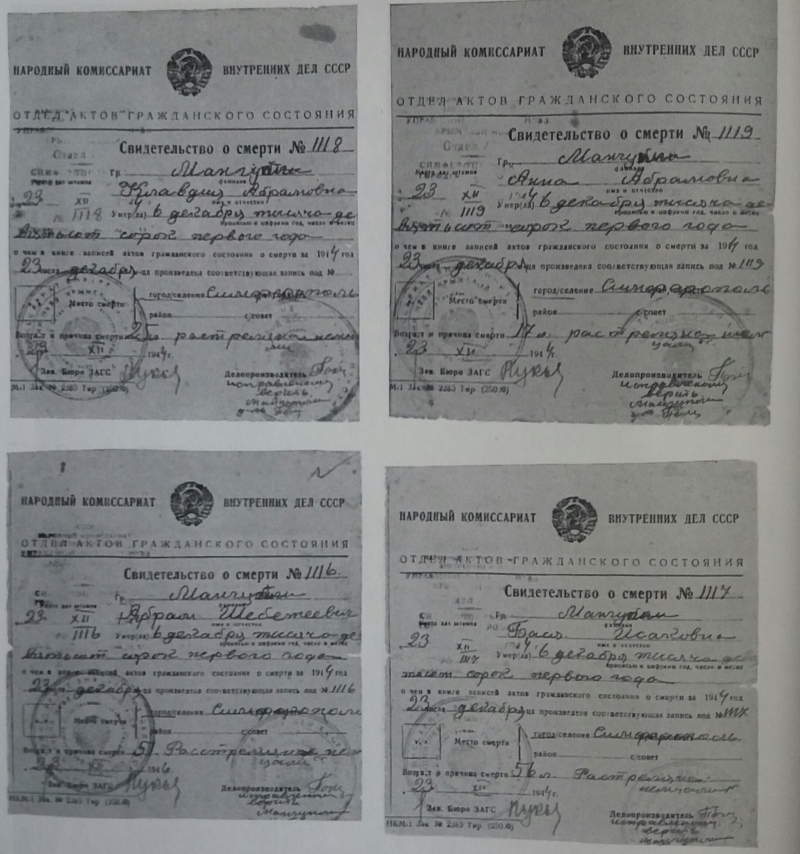
However, what Mom learned about the fate of Izya, who didn't manage to leave the besieged city for Barnaul and went to the partisans, and about the son of Shebetey and Dusya, struck her right in the heart. From the first days of the war, Shebetey went to the front. Kissing his wife and little Mishutka, he said: "Wait for me. I will definitely return!". He didn't return. He died from a lethal enemy bullet after May 9, 1945. Well, Dusya took her own toddler to the Gestapo and said: "Here, take him. This is a Yid's son." Trying to please the monsters, she told them where they could find Izya. Obviously! A partisan, to boot. The boy wasn't just shot. He was brutally tortured, but he remained silent. Then they tied the partisan to a wagon and set the horses running along the cobblestone pavement. Neighbors also revealed that Dusya had turned her husband's 14-year-old cousin, Liza, over to the Gestapo as well.
"Could my brother's predictions really have been prophetic?" Malka thought. "And I have to live with this grief for a long time, live for all of those who have no graves in their native land, whose names no one will ever read on a marble slab..."
The roots must have been strong...
One warm May morning, Dad called Sofiyka:"Come here, daughter, look at this miracle."Sofiyka runs up to Dad and can't believe her eyes—from under the ground, having fought its way to the light, a delicate green carved leaf stretches upward.
Warmed by the sun and love, this little bush will grow into a large tree over the years. Its luxurious arbor will yield ripe amber clusters of grapes every autumn. They will surprise with their beauty, delight with their sweetness. The roots must have been strong, and the father's heart—kind.
Sofiyka understood long ago that it is not only goodness that reigns in this world. Once, when she was rehearsing the role of Ulyana Gromova from "The Young Guard" at the Pioneer Palace, her bread ration cards were stolen from her purse. The fear that she had left the whole family without bread for an entire month tormented her, gave her no peace. How to tell Mom about it? She'll be so upset. And who to ask for advice?
Their neighbor, Tatyana Makarovna, works at the church. Sofiyka often runs over to help her around the house. The old woman has lost her sight and sometimes asks to be escorted to the church. For the girl, it's no trouble at all. Especially since the House of God is not far from their home; cross the road, go up the hill—and the gilded dome is already visible above the crest."Don't cry, my dear," Tatyana Makarovna soothes her. "God sees that it's not your fault. I will talk to your mom myself. And I will help."
The girl didn't yet know how the old woman would help, since she and her disabled husband had nothing but their own rations. But for the whole month, she brought a little something from the church—some bread, some small pies, some buns. Parishioners donated all this to the poor. And of course, it wasn't at all superfluous for them either.
Sofiyka grew up, learning to understand herself and others. Time passed. Larisa had grown up too, becoming a first-grader. One day she returned from school in tears—Valyushka, her desk-mate, had stolen her lunch from her briefcase. Sofiyka had seen Mom wrap two pieces of black bread with a thin smear of some kind of fat in newspaper that morning. There was nothing else in the house.She pulled her little sister close and calmed her:"It's not good to take things without asking, of course. But you, Larochka, must understand: she wanted to eat, too. Forgive her and don't be angry. Come on, let's go, I have a treat for you right now." She led her sister to the grape bush. "Look what we have!"
She hadn't cut this very first ripe cluster of grapes for a long time, waiting for it to swell with sweet juice. And it seemed that exactly the right moment had now arrived, the one she had been waiting for.
Half a Century Later
"Hello, dear Mommy. First thing I did was finalize all the documents needed for permanent residency here in Israel. And immediately, I set to work on permanently registering your parents and loved ones on this land. I submitted the documents confirming their execution to the Holocaust Museum. And I hope that at least now, your aching soul will find some relief—the names of the people so dear to all of us are not just recorded in the Book of Memory. It is believed that if victims of genocide have no graves on earth, they have found them here, in the 'Yad Vashem' museum.
"You know, I walked through the halls of this museum for a long time, where every exhibit seemed not only to tell the tragic story of millions of people. It literally pierced my heart with pain.
"But what I felt in the memorial hall for the children who died at the hands of fascist executioners cannot be described. The talent of the project's creator has produced something, I think, unlike any other museum in the world. Imagine: the lights go out, and you find yourself alone with the night. Above your head is a dark sky, scattered with myriads of stars. Every star, one must understand, is the soul of a child whose life was taken. Fragile, pure, and bright, it flew away to another world and remained there forever. To remind us from time to time: 'People, remember!...'
"And there I was, alone with these living stars. A melody played softly, and it was as if the first and last names of the children were woven into it. A soulful female voice imprinted these names onto my soul. And I mentally continued the sad list with the names of my cousins—Mishenka and Zorik, whom I never had the chance to know, but the pain of whose loss was passed on through the pain of your heart, Mommy.
"You know, I don't want the echo of war to resonate with such piercing pain in the hearts of our children and grandchildren. It's a good thing that the further time passes, the more it dulls the perception of past events. But, I think, the past shouldn't disappear into nowhere. When Sofa's granddaughters read about how everything happened, they'll understand their grandmother better, and perhaps find her traits in themselves. When mine grow up—I will tell them everything too.
"Who knows, perhaps this is how each of us will be able to understand that we don't just belong to ourselves, but that we are continuing the endless lifeline of our family. And that a star that falls once will not burn out. Its radiance will pave the way for other stars, other lives. A path illuminated by the light of goodness and peace.
I love you, Mommy.Haifa, Israel, 2003"


Comments